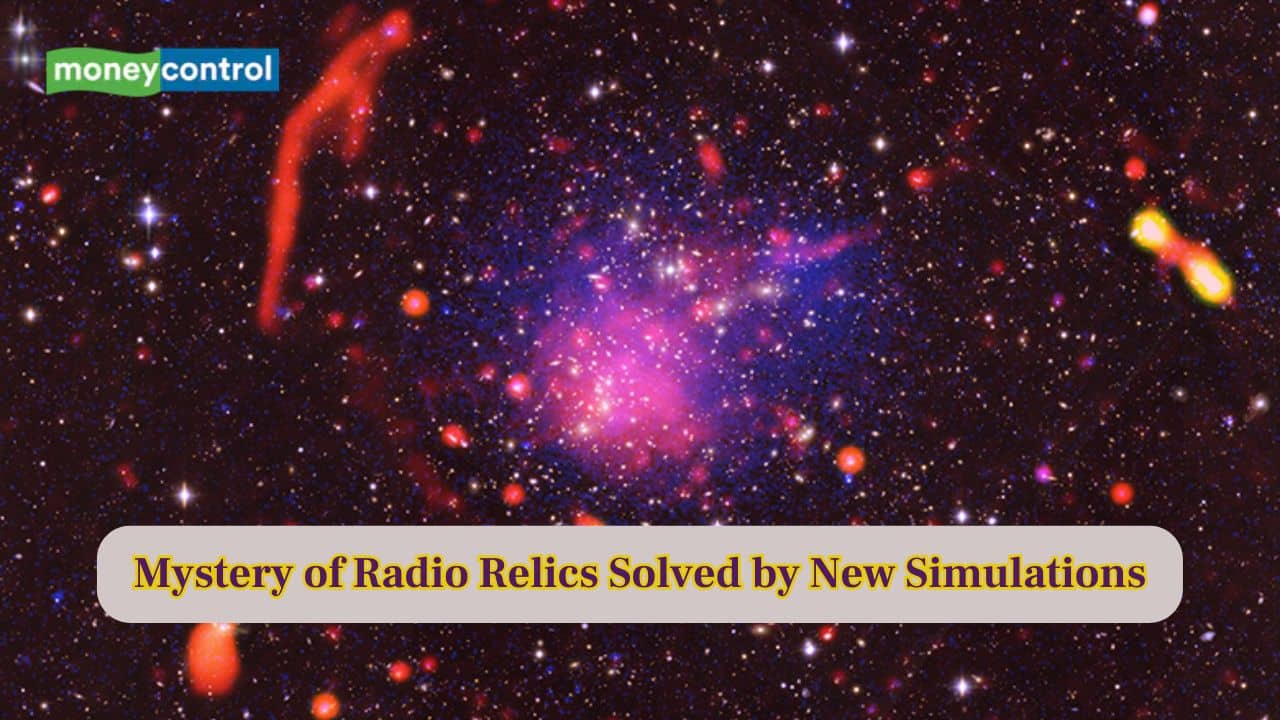
Radio relics are intriguing astronomical phenomena found in galaxy clusters, characterized by their ghostly arc shapes and the radio waves they emit. These structures typically arise from the massive collisions of galaxy clusters, a process that occurs at incredibly high velocities. While the strong magnetic fields associated with radio relics have baffled scientists for decades, recent advancements in simulations have shed light on their origins and behavior.
When two galaxy clusters collide, the resulting shocks accelerate electrons to nearly the speed of light. This acceleration produces synchrotron radiation, which manifests as the glowing relics we observe. To better understand this process, researchers conducted detailed simulations of a merger event, specifically focusing on two galaxy clusters where one was significantly more massive than the other, with a mass ratio of 2.5 to 1. These simulations revealed that the shocks generated by the collision result in enormous fronts that can stretch millions of light-years across.
The essence of the discoveries comes from examining the chaotic interactions of gas within the clusters, especially at their edges. By employing “shock-tube” simulations, researchers were able to zoom in on these turbulent interactions, unraveling the conditions that give rise to the bright radio emissions characteristic of radio relics. The findings indicate that turbulence and compression during these encounters significantly enhance magnetic fields within the clusters, leading to radio emissions much stronger than previously anticipated. Interestingly, this also explains the often observed discrepancy between intense radio signals and weaker X-ray emissions in these regions.
The significance of this research extends beyond the immediate findings about radio relics. It exemplifies how simulations serve as crucial tools in resolving complex astronomical puzzles. The interplay between shocks, turbulence, and magnetic fields revealed through this study underscores the dynamic nature of galaxy clusters and their evolution over time. As radio relics act as markers of these processes, they not only offer a glimpse into extreme physical phenomena in the universe but also prompt further exploration into other phenomena that remain to be explained.
Looking ahead, researchers are keen to investigate various unexplained aspects of radio relics further. Future studies are expected to refine existing models and align them with new observational data. This ongoing research aims to deepen our understanding of cluster physics, cosmic magnetism, and the broader implications of violent cosmic events, enhancing our grasp of both particle physics and the universe itself.